HIPG sees stronger opportunities as container shipping’s return to Suez gathers pace
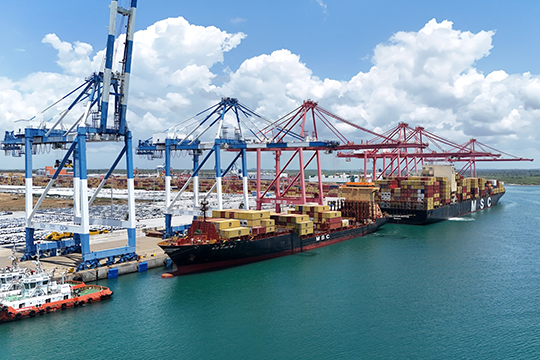
Hambantota International Port Group (HIPG) has welcomed the prospect of a sustained return of container shipping through the Red Sea and Suez Canal, saying the recovery of the main East–West shipping corridor could strengthen Hambantota’s commercial position as it prepares to increase annual container handling capacity to two million TEUs in the first quarter of 2027.
The assessment follows maritime consultancy Linerlytica’s October 2026 outlook, which forecasts a full-scale return of container shipping to the Suez route by the first quarter of 2027. The return is already progressing service by service, although its pace remains subject to security conditions and individual carriers’ operating decisions.
Bindu Ranasinghe, HIPG’s General Manager – Commercial and Marketing, said that while Red Sea disruption had accelerated Hambantota port’s entry into container transhipment, a sustained return to the established route could create a larger opportunity for its next stage of growth.
“The Red Sea disruption advanced our container project. Congestion in Colombo Port created a requirement for additional capacity, and we began accommodating overflow cargo with the resources available to us in April 2024,” Ranasinghe said. “That experience encouraged us to proceed with a full-scale operation and further investment. With expanded capacity coming into place, we welcome the prospect of shipping returning more fully to the Suez route.”
HIPG commenced its inaugural MSC container transhipment service on April 9, 2024, and has since committed US$149 million to new container handling equipment as part of its capacity expansion programme.
Located approximately ten nautical miles from the main East–West shipping route, Hambantota offers a geographical advantage for services using the Suez corridor. Ranasinghe said that advantage becomes more relevant as carriers shift away from diversions around the Cape of Good Hope. “When vessels use the established East–West route through Suez, they pass much closer to Hambantota. We have used the period of disruption to expand our capabilities, and a sustained return to that route would give us a stronger opportunity to attract business,” he said.
The opportunity would extend beyond container handling. With an estimated 75% of East–West tonnage currently routing around Africa, a return of more vessels to the established Suez corridor is expected to increase demand around Hambantota for bunkering, ship supplies and other marine services.
“As more tonnage returns to the main East–West route, the requirement for services such as bunkering and ship supplies is also likely to grow. Hambantota’s location gives the Port and the surrounding region to serve that wider demand,” Ranasinghe added.
HIPG is also preparing to develop gateway container cargo, enabling Sri Lankan businesses to use Hambantota for imports and exports alongside its transhipment operations, which involve transferring containers between vessels.
The port’s industrial park, surrounding Board of Investment zones and proposals for further industrial expansion could support the development of this domestic cargo base. A planned container inspection centre is expected to facilitate gateway operations, with benefits anticipated from the first quarter of 2027.
“To attract more shipping lines and services, we also need gateway cargo,” Ranasinghe said. “Industrial development within and around the port, together with the inspection facilities we are establishing, will help create the conditions for that business to grow.”
He distinguished the outlook for Suez from developments affecting the Strait of Hormuz, where disruption to access to Gulf ports has encouraged alternative cargo arrangements. Hambantota has served as one of those alternatives, handling transhipment cargo for onward feeder connections to accessible regional ports.
While improved Gulf access could see some cargo return to previous arrangements, Ranasinghe said changes would also depend on commercial commitments, existing service networks, insurance terms and assessments of security.
“Shipping lines and their customers have established alternative arrangements, and those networks will not necessarily change immediately,” Ranasinghe said. “Throughout the disruption, our approach was to understand what customers needed and provide practical, commercially workable solutions. Customers have recognised the professionalism and reliability of that response. Where the connections developed through Hambantota Port continue to deliver commercial value, there is a strong case for retaining them even as regional access improves.”
HIPG said its focus remains on translating the capability developed during disruption into sustained customer relationships. By combining transhipment and gateway cargo with industrial activity, bunkering, ship supplies and other marine services, the Port expects to capture a broader range of opportunities as traffic patterns across the region begin to normalise.